
How to Read and Understand a Research Paper in a Short Span of Time?
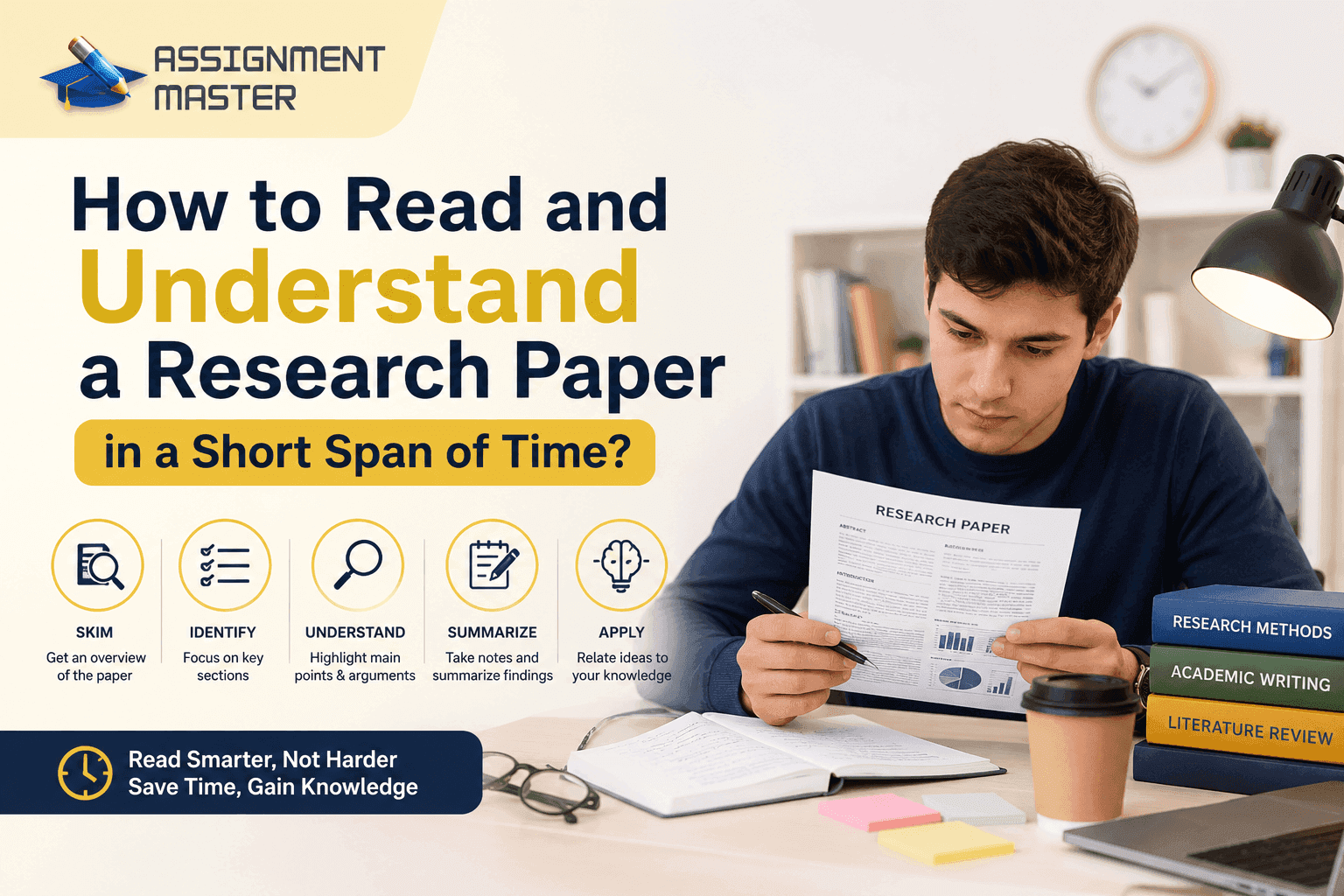
Reading a research paper swiftly involves knowing what to look at first. It does not involve running through every sentence. Having this skill is quite significant, not only for the readers but also for the one who is drafting their research paper or any detailed document. Writing a research paper is one demanding and time-consuming task. And, if one does not know how to skim through the important details when they are done writing it, reading becomes as challenging as crafting it.
A better approach here is to formulate the research question, conduct a search for evidence, and pace yourself when reading the important claims presented by the writer. This will make it easier to understand the argument, but you won’t give equal emphasis to each paragraph.
Why Do Research Papers Matter? A Complete Introduction
A research paper is a written report that includes a research question, a report of the research conducted to answer the question, evidence, and an interpretation of the evidence. Usually, primary research studies have the following parts.
- The title
- An abstract
- An introduction
- The methods
- The results
- The discussion
- The conclusion
- The references
- The supplementary material
This arrangement may differ from discipline to discipline and journal to journal. The introduction introduces the problem; the methods outline how the work was conducted, the results summarise the studies, and the discussion explains the results.
These qualities enable people to have an illustration of what they are going to experience before they begin. Use the paper as a conversation, not a book of words. The first step is to determine the author’s intended proof, investigation, or clarification.
Where Should the Reader Start from Before Analysing Each Word?
Let’s take a look at the strategy!
If you are starting to read the research paper, there is no need to observe each line at a time. Allocate 2-3 minutes to setting up the identity of the paper. Read the title, authors, year published, journal, abstract, headings, figures and tables, and conclusion. Then ask,
- Which question are they asking?
- What did the scientists observe?
- What seems to be their most important discovery?
Make a one-sentence prediction of the message of the paper. It sets up a mental goal. Then go ahead and test if the evidence does support that prediction.
This reconnaissance also lets you know if the paper should be read in its entirety. A source can be helpful for one finding or one background point, or the entire method. It is not always necessary to use the same depth for each paper.
How Does Improved Reading Help Your Own Learning?
When you can get evidence easily, you can research easily. Studies can be compared based on design, findings, limitations, and relevance rather than on the basis of general impressions.
The quick read at the core of these strategies should not be rushed, but directed. If anyone is facing a problem in planning or structuring, authentic thesis help can save time. But source evaluation is still your own responsibility.
What is the Best Strategy to Read Each Section of the Paper?
The fundamental approach for skimming the paper remains the same throughout. It is to seek purpose, evidence, and meaning. But how to look for them varies by section. Efficient reading does not mean applying the same strategy all the time.
Begin with an Abstract
Recognise the research question, general approach, key findings, and supposed conclusion. Record significant findings or conclusions. But do not make your final judgement here. The abstract is a brief statement by the authors, and subsequent sections will demonstrate if the claims presented by the author are supported.
Look for the Introduction to Find the Gap
Read the beginning of the report quickly, then read around the research problem and objective. Search for the place where proven information ends and the authors describe what is in question.
Complete the understanding of the purpose of the study. If the research gap cannot be stated in one or two sentences, reread only the relevant paragraphs.
Treat Methodology as a Credibility Check
Different speeds of reading are needed for methods defined in the paper. One does not need to memorise all the instruments and procedures at first. Specify the study design, participants, samples, variables, controls, measures, and analysis plan.
Next pose: Is this a method that could reasonably answer the question?
Reduce the speed of the methodological decisions that could affect the interpretation of the results. Here, quick reading has to be exchanged for careful reading.
Read Results First from Figures, Then from Tables
Visuals are often more helpful in understanding results. Read each key figure and table before the surrounding paragraphs. Interpret a caption, determine what was measured, make comparisons, and record the outcome as positive or negative.
Next, go back to the text. The prose should tell what evidence shows and not take its place. Be on the lookout for statistically significant but small findings, or results that only partially answer the original question.
Approach Discussion to Interpret Findings
The discussion is for the purpose of determining the meaning of the findings. Distinguish between evidence and interpretation. Marks makes statements about implications, comparison with previous studies, limitations, etc., and future work. Watch for generalising the language to the data. Persuasion can be an argument, but it is not proof.
Scan References Strategically
There is no need to verify each reference given in the study. Follow the source of information central to the argument, particularly if the claim is important, surprising, or controversial.
What is the Rapid Yet Effective Reading Sequence?
Do you ever wonder how professional research paper writing service work so swiftly when students hire them for proofreading or editing purposes? It is because they use a three-pass writing technique, depending on the purpose.
Pass One is to Map the Paper. Read the title, abstract, headings, figures, tables, and conclusion. Take about 5-10 minutes to determine what it is about.
Test the Argument in Pass Two. Analyse the introduction, main findings, and relevant methods. Determine the question, evidence, and connection to the question.
At Pass Three, Look for Only What is Important. Go back to the confusing procedure, statistical information, new jargon, or claims that require verification.
This is quicker than reading twice. It also avoids a common problem like taking 20 minutes to understand a minor detail before determining whether the paper is relevant.
How to Remember What You Have Read?
When it comes to remembering the study you have read, instead of highlighting entire paragraphs, make a list of five elements.
- Research question
- Study design
- Most important finding
- Main limitation
- What is the importance of the paper to your work?
Include one last line. What would I challenge or check?
This question turns passive reading into active analysis. It also helps your writing later on as you capture your response, not just the authors.
When is Slow Reviewing Required?
No matter how fast you are, you should not sacrifice understanding, especially when it comes to reading research papers. Take your time when the paper contains your dissertation, you are planning to quote a specific claim, or when the method might affect your research design.
Slow down when dealing with negative results, unexpected results, statistical interpretations, and limitations. These regions may include the distinction between the study found X and the evidence shows Y.
How This Skill Helps Beyond Research Papers?
Academic reading is an effective way to enhance one’s judgment. You develop a sense of the difference between a strong claim and a confident claim, evidence and interpretation, and useful detail and background information.
Having this skill can also enhance writing as well. As you watch researchers formulate questions, present evidence, qualify conclusions, and recognise limitations, you gain a better understanding of academic structure.
Where Do Common Reading Mistakes Start?
One does not realise but blunders happen unintentionally.
- First is looking for the details rather than the purpose before beginning to read for the details of the purpose.
- Another is to scan all sentences the same way and give them equal attention.
- Last is accepting the conclusion the authors come to without evaluating the design and argument.
Students also often will start stopping to look up each unfamiliar word, which disrupts their argument with the author. Instead, they should look up words that really block their understanding.
If you are about to start on a write my term paper assignment, this will be a super useful skill. You will be able to gather useful resources before you start filling paragraphs, instead of finding research at the last second.
FAQ
How long does it take to skim a research paper?
An initial quick scan can take ten minutes. Detailed, critical reading may take an hour or more. The time required depends most on your objectives, but more on the difficulty and depth.
Should I scan the abstract or the intro first?
It depends on how familiar you are with the subject. For a new topic, the introduction provides more context before the abstract. For an overview and quick assessment, abstract first is quicker.
How do I read a paper when I don’t know the terminology?
The trick is not to stop for every unknown word. Underline any words which appear a few times and which you guess might be central to the text, continue reading for context for a while longer, then look those up together.
Should I read all of the papers my professor recommended?
Not if you can avoid it. Ask first question if this paper directly address part of my research question, provide background to my project, or provide methods I might use?
How do I analyse papers more quickly for my literature review?
Make a list of the information or ideas you want to find out as you read. In the course of analysing, identify evidence for those themes and determine whether they agree, disagree or imply a lack.
How should I approach reading the paper for an assignment tomorrow?
Start by identifying the research question, important figures, results section, the conclusion, and discussion section. Then look critically at the methodology for any limitations, then decide what you can credibly evaluate, based on the assignment parameters.
The Bottom Line
No research reading strategy needs to prioritise speed of finishing. The more useful habit is training yourself to bring your focus of attention to information which would potentially shift your working belief of the project at hand. Map, find, inspect, test, and record. This will be faster over time and, importantly, will refine your judgment about research. Even better, it will help transform the activity of reading research from homework to an object of management and control.