
3 Common Mistakes Students Make on Their UK University Application
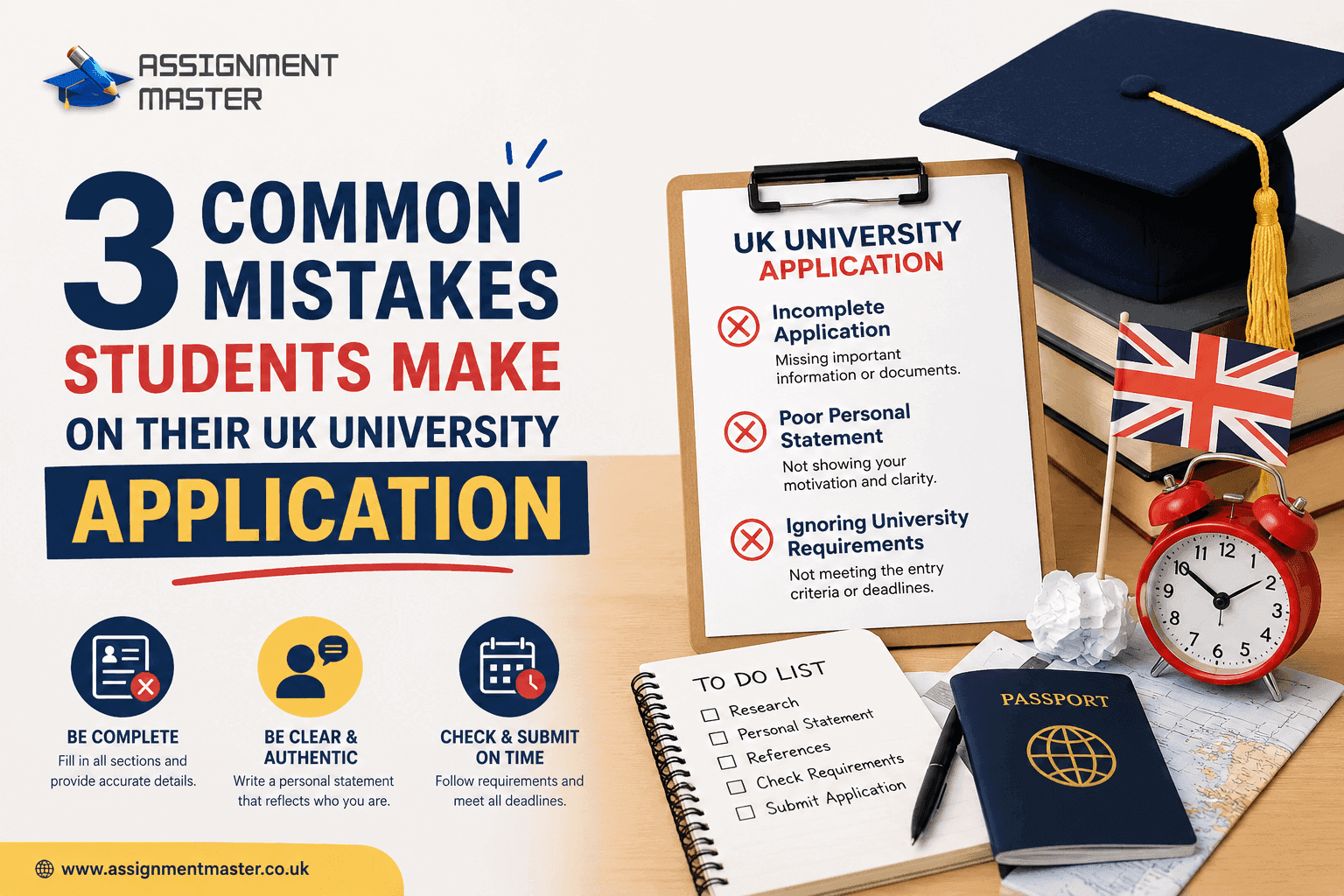
The whole process of getting admission to the university is quite challenging for students. At this crucial stage, they make errors like selecting courses without verifying requirements, filling out an application with incomplete or incorrect information, and waiting until the last minute to complete steps. Each reduces the effectiveness of a good application. Luckily, all these blunders can be prevented through a bit of planning.
The primary way of applying to university in the UK for most undergraduate students is through UCAS. Students must have accurate personal and educational information, course preferences, references, and a personal statement. Requirements and deadlines, however, may differ from course to course and university to university, so it is important to check the individual course pages.
What is Really Needed for a UK University Application?
To identify common errors, it is important to know what students should be working on. The UCAS undergraduate application contains the following fundamental elements.
- Information about themselves and others
- History of education and qualifications
- If applicable, employment details
- 5 course options
- A personal statement
- A reference
- Submitting the final bill and paying for the work
The UCAS format of the personal statement has been altered for entry in 2026. Rather than a single statement, applicants are asked three questions, the first two of which ask about their motivation and preparation to enter the career through education, as well as any experiences outside of education that are relevant to the career.
Students should also find out if there are any other requirements for their selected course. There are earlier deadlines for medicine, dentistry, veterinary courses and Oxbridge.
The other important exception is. Undergraduate applications are made outside UCAS through the Open University. All applications are made via its website and most undergraduate courses have no formal entry requirements. That is enough to indicate that no two UK universities are the same.
What is the Initial Inspection Students Need to Make Before Submitting?
When you finish writing your application, review it carefully, but don’t make every change. Check your name and contact information first. Then check out qualifications, grades, dates, course titles, and university options.
Verify that your reference has been added. Re-read all the personal-statement answers. Identify incomplete sentences and repetitive ideas and claims unsupported. Make sure your email address is checked as well. The main email on the application is where UCAS and the selected universities and colleges send emails. Do not submit when the application looks finished. Submit if the information provided is accurate.
Where Do Students Go Wrong When Drafting Their University Applications?
1 – Selecting a Course Without Evaluating Its Requirements
Why Does This Happen?
Sometimes students start with information about a university’s ranking, location, or reputation. These are important but should not be overlooked when considering the actual course.
The modules, assessment approaches and entry criteria for two degrees that have nearly the same name can be quite different. Specific subjects or grades may be required. One can have more varied qualifications.
International students have one more obstacle. They may have to be measured against the accepted entry grade of any university they are applying to. There may also be a requirement for English-language skills.
What Can Go Wrong?
Suppose that a student enrolls in a course because the name of the course seems appropriate. Later, they find that their old subjects do not satisfy a certain condition.
If the course is not a good match, the personal statement may not be as convincing, even if the university decides to make an exception and consider the application. It is even harder to explain a true interest in a programme which they have researched very little.
The Smarter Approach
Make a basic course comparison before adding options to UCAS.
| Inspect | What to Examine and Confirm |
| Entry Requirements | Grades, Subjects, and Qualifications |
| Course content | Core and Optional Modules |
| Assessment | Exams, Coursework, Projects or Placements |
| Location | Campus and Study Arrangements |
| Additional requirements | Tests, Interviews or Portfolios |
| Deadline | Course-Specific Application Date |
Next, review the course page of the university. Avoid completely relying on rankings of websites or social media posts. It is also advisable that students who require academic support do not prepare applications in conjunction with assessed university work. It may be beneficial to look for university assignment help later in their studies, but admissions will be based on their abilities and application.
2 – Using the Personal Statement as an Ordinary Essay
The Real Problem
A personal statement should be more about the applicant than a list of good words. The common error is to include anything like,
⨯ I am passionate
⨯ I am hardworking
⨯ I have always dreamed of attending university
These claims are empty unless there is evidence to substantiate them. Another issue is that writing one generic explanation that could be used for virtually any course. The UCAS application for entry in 2026 will have three specific questions to which the applicant must answer. That renders relevance even more relevant.
If you are looking to build your answers, here is a better way to do it.
Use evidence instead of adjectives. Instead of adding vague statements, describe what was responsible for that interest. Maybe you did a project in the subject area, followed an issue in a business, or did independent study. Next, link the experience with the desired degree. A useful structure that can be followed by potential students is,
Experience → what you learnt → why it matters → what you want to explore next
This provides readers with something convincing. It would also be best for students not to copy examples found on the internet. Having an application written is totally different from having feedback on the application writing. Your application should be a true reflection of your own experience, interests, and preparation.
The Last Check Before Submission
Read each of the answers and ask yourself some questions before submitting the application.
- Would another applicant be able to copy this paragraph without changes?
- Am I providing support for my statements?
- Is the answer to the question?
- Does it give reasons for why my experience is important?
- Is the wording similar or the same as what I would actually say?
3 – Waiting till the Last Minute to Submit References, Qualifications, and Deadlines
This blunder appears to be a management error, but it poses significant risk.
Where Do Students Go Wrong?
An applicant may complete their personal statement before the submission, but not realise that the document also requires a reference. UCAS claims that a reference is required and must be submitted along with the application. Students should request a reference early, as it will take time to write a useful one.
There can also be problems with education history. Students occasionally provide answers to questions without reading them when they ask someone else to do my assignment for me, and so miss out on the correct dates, grades, or qualification names.
That information is important because universities require a clear picture of the academic background of the individuals.
Avoid Using a Deadline Buffer
A better way to resolve this issue is to not set the official deadline as your own. Set three dates.
Four Weeks Prior. Complete course research and collect documents.
Two Weeks in Advance. Fill in the application and validate the reference.
Several Days Before. Final accuracy checks and submission.
This allows for unforeseen problems to be addressed. Also, keep in mind that there are different deadlines. For many medicine, dentistry, and veterinary applications and for most undergraduate courses, as well, UCAS has a later date than the other ones.
What Are the Ways Students Can Avoid These Issues Before Applying?
- The simplest approach is to see the application as a small project, in place of one application.
- Start with research. Consider courses at other universities when creating a short list, not only for reputation. Save the official course pages and note their needs.
- Then create an app folder. Store qualification certificates, dates, grades, evidence of English language if applicable, employment details, and other relevant information in a single location.
- Write your personal statement responses on your own. This simplifies editing and eliminates hurried writing within the application portal.
- Lastly, have a trusted party verify accurate information. They should correct spelling, dates, and clarity, not rewrite your experiences for you.
- Many reputable and professional assignment writing services are not just limited to the application process. They can also be useful once a student has been accepted to a program, especially in essays and research projects.
- But at the same time, these service providers cannot be mistaken for doing wrongful academic exercises or copying the work of another student.
FAQs
Is there a way to apply for UK universities without UCAS?
UCAS is the preferred choice for most applications to universities for undergraduate courses. In some institutions, there are separate processes. For undergraduate courses, for instance, the Open University will accept direct applications.
Is it possible to apply to more than one university in the UK?
Yes. Five choices are available for undergraduate applications at UCAS, but there are also some course restrictions that apply. So, it is advised to check beforehand to avoid any mishaps.
What if I missed the main UCAS deadline?
While some courses may accept applications after this date, there will be no guarantee of equal consideration. Eligible applicants may also avail of routes of Extra or Clearing depending on their situation.
To Conclude
Successful applications to UK universities showcase individuals being accurate, relevant and prepared. Avoiding big issues can be possible if students find out what it takes to be admitted to the course they intend to take, they prepare their personal statement questions with authentic evidence, and they allow for time to get references and verification. Best applications are usually not rushed. They are a testament to the applicant’s knowledge of a course, their ability to explain their preparation clearly, and the fact that they took responsibility for every aspect before submitting.