
Top Tips to Ace Your Tort Law Assignment in the UK
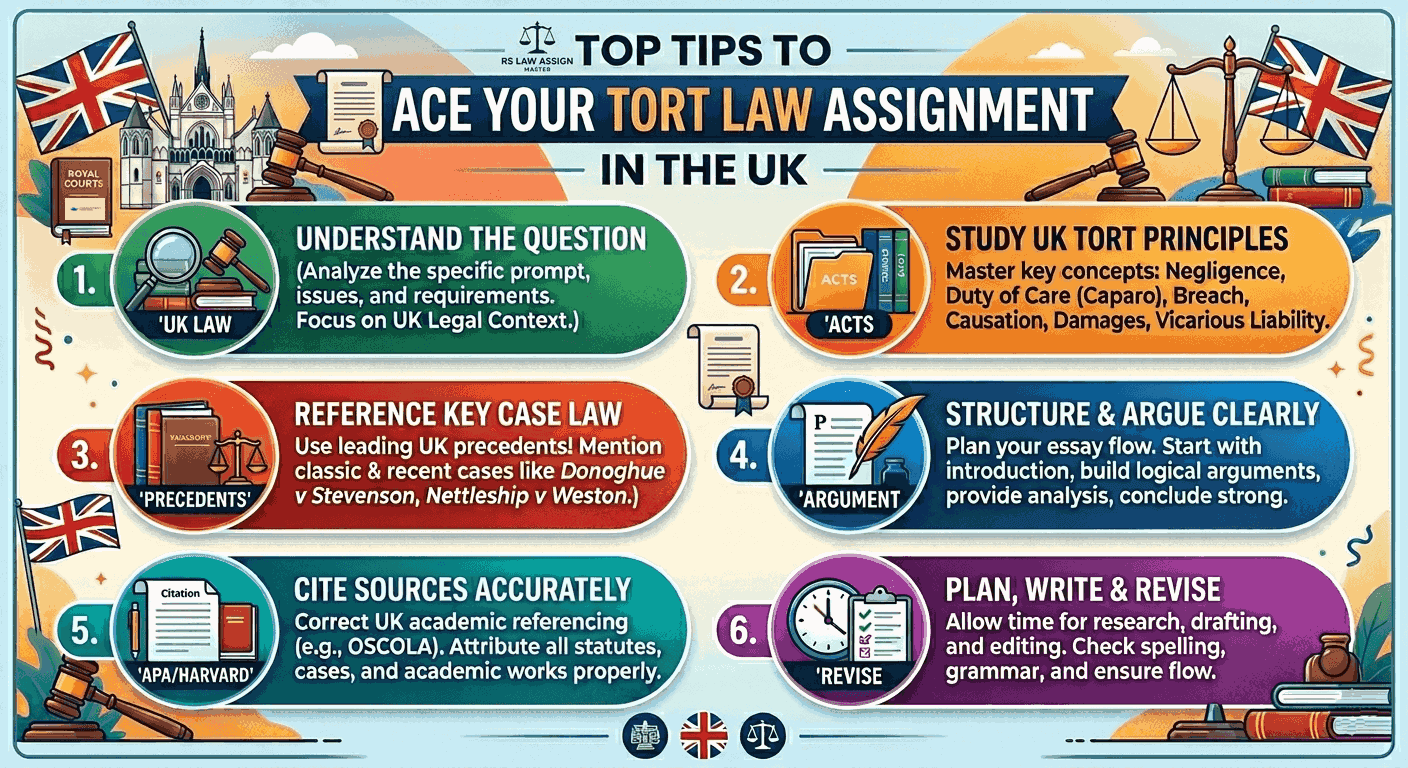
Law assignments are undoubtedly the most challenging academic tasks, and when we talk about tort law, it is one of those subjects that initially appear easy. But if we go in depth, when students actually begin writing assignments, they seem to know that they have to apply factual scenarios to meet the expectations of the examiner.
On the surface, tort assignments have concepts like negligence, duty of care, and liability that seem manageable. Many students lose marks because their content lacks the implementation of these principles in reality. Also, structuring their analysis with legal reasoning in the wrong way also completely shifts the dynamics.
What lecturers expect is how you, as a student, interpret situations, evaluate arguments, and justify conclusions in a structured framework. Success goes beyond simply writing legal terminology. It is when you treat tort law assignments as a problem-solving exercise and prove to the examiner that you are ready for the practical world and can handle the cases effortlessly.
What Is Tort Law, and Why Do Students Have to Study It? Let’s Find Out!
Tort law is a part of civil law that addresses the case of one individual causing harm, injury, or loss to another person. It deals with the legal liability and damages for negligence, nuisance, defamation, occupier’s liability, and other claims. Tort law, in layman’s terms, is
The law that establishes legal responsibility when one party’s actions cause harm to another.
So why is it that students are required to submit assignments for Tort Law?
Students must complete tort law assignments because they encourage analytical thinking and practical legal reasoning. Universities aim to teach students both legal theory and its practical application to actual situations.
That is why tort law assignments usually include factual scenarios that students must assess using case law and logical reasoning. If you think being successful in tort law is about memorising definitions, then you have not understood the right context behind it. It is actually about showing how to perform a structured analysis, think critically, and relate the law to practical results.
Because of the complexity and very close attention to the small intricacies, students are often inclined towards taking Tort law assignment help UK. It helps them understand the concepts on a broader and meaningful level.
What are the Key Elements of a Good and Successful Tort Law assignment?
While explaining how you can write a tort law assignment, we wanted to let you know that a well-written assignment will not restate legal rules. It demonstrates to the examiner an understanding of the practical application of law.
Why is Application Preferred Over Long Definitions in the Assignments?
Do you know what the most common pattern that has been observed among law students in the UK when they are asked to give assignments on Tort law is? It is devoting excessive time to stating the law and not enough time to applying it.
For instance, students may comment on negligence in an assignment, and tend to include lengthy paragraphs describing what the duty of care is. At the same time, you will observe very little analysis of whether the defendant actually failed to uphold that duty.
Take a look at this example of a scenario involving a slip and fall claim.
Think about a customer slipping on a wet supermarket floor, and no warning sign was visible. If you give a weak answer, you will only give a general definition of negligence.
A Strong Response Would!
A better answer would consider whether or not the supermarket should have been aware of the risk, if any preventative steps were taken, and if the injury was foreseeable. It is in the practical application that real understanding is shown.
How Does Structure Quietly Affect Your Grades?
Many students lose marks because their arguments do not seem to be organised. They overlooked the fact that legal writing is not solely about understanding the law, but also about stating the reasoning clearly and logically.
The IRAC Method is Helpful, but It is Not Always Used Properly
Most students are familiar with the IRAC format, which is
- Issue
- Rule
- Application
- Conclusion
But many students follow it in an overused and mechanical manner. Examiners will be able to spot any formulaic analysis easily. What you have to do is not use IRAC as a blueprint, but rather as a guideline for clarity.
For example, in considering occupiers’ liability, start by stating the precise issue of the question and then state the statute or case law you are using.
Then focus the majority of your energy on interpreting how the facts relate to those principles, rather than summarising judgments too much.
That analytical balance is mostly what distinguishes ordinary assignments from outstanding ones. Almost every law assignment writing service will also emphasise that you take notes on this approach.
How Important Is Case Law in Tort Law Assignments?
While case law is the foundation of tort law writing, it is more important to use it effectively than just to cite cases.
Common Mistakes Students Make When Using Case Law
Studies show that many students write the name of the case without explaining the reason why they are relevant. This reduces the strength of the assignment as it seems more descriptive than analytical. The examiner is familiar with the case. They aim to see how well you can relate the precedent to your facts.
Scenario Example: Donoghue v Stevenson
Assume your research paper needs to address a manufacturer that has caused consumer harm with a faulty product. Here, the reference to Donoghue v Stevenson is not sufficient.
A good answer makes clear how the neighbourhood principle led to a duty of care between manufacturers and consumers, and assesses whether the facts in the modern world meet the principle. This method demonstrates legal thinking and not memorisation.
Students who heavily depend on a generic summarisation made by the internet may have trouble with the analysis because it seems detached from the problem question.
What is the Importance of Conclusions That Students Are Not Aware of?
Now we are going to disclose the part where students will learn that their writing requires strong conclusions and that these conclusions are more important than they realise.
You will see many individuals tend to rush to conclusions, as they spend a lot of their energy on analysis. Conclusions are where examiners are concerned with how well you have connected your reasoning.
Refrain from the Safe Conclusion Trap
One of the most significant things that signals that a conclusion is weak is the vagueness in the statement.
╳ Whether the claimant will be successful will depend on the facts.
This is the weakest response that does not answer. A stronger conclusion considers both arguments and arrives at a reasoned position.
✔ It is likely the claimant would prevail even if the defendant raises the defence of contributory negligence, due to the lack of warning signage.
In tort, while there may be no certainty, there is a requirement for judicious judgment.
How Real World Thinking Improves Tort Law Writing?
The best way to write exceptional tort law assignments is not to think of legal problems as being solely academic.
Think Like a Lawyer, Not Just a Student
The best law students always ask questions when working on their assignments, as this approach helps them produce content that truly impresses the examiner.
- Was it a potentially preventable injury?
- Could the harm have been predicted?
- Would the court consider the defendant’s behaviour reasonable?
These questions are used because they address responsibility and fairness in tort law, both of which contribute to deeper legal analysis.
Scenario Example: Negligent Medical Advice
Suppose a physician does not inform a patient of potentially harmful side effects before treatment. Rather than just giving a general discussion of medical negligence, strong students analyse informed consent, the foreseeability of harm and whether another reasonable doctor would have acted differently.
This hands-on approach gives assignments a more advanced and realistic perspective. Many students do better to learn about the structure of legal reasoning than to just look at the answers given by their supervisors on sites such as Assignment Master.
FAQs
What is the most common mistake made by students when completing tort law assignments?
The most noticeable mistake observed among students is concentrating too much on clarifying legal regulations and not enough on applying them to the particular facts of a situation.
How many cases should usually be included in the assignment?
Make sure that the quality of your assignment is top-notch, as it is more preferred than the quantity. A thorough analysis of a small number of relevant cases is much better than mentioning several situations without providing context.
How can I get better at legal analysis?
Instead of just memorising case summaries, practise applying legal principles to actual situations. This practical application enhances analytical thinking.
Should tasks involving tort law sound really formal?
Although they should sound exact and professional, clarity is more important than complex explanations.
Make Analysis the Foundation of Your Focus
Successful lawyers are recognised for their analytical thinking and attention to detail. They get recognition and acknowledgement because they are aware of how analytical and critical thinking are the top-most priority in the challenging and complicated domains like law. Tort assignments provide individuals to showcase their inner talent and their way of dealing with real-life cases. Successful law students are those who pay close attention to even the smallest legal details.