
Agile vs Waterfall: Write A Better Project Management Assignment
The brief is open on one side of the screen, a case study about a mid-sized firm moving its customer records to a new system. At the bottom it asks you to justify your choice of methodology. You have read it twice. You know what Agile and Waterfall are, but explaining them and defending one for this firm feel like two different jobs.
Deciding what to show, in what order and how much of it a marker needs to see is what slows management assignment writing down, more than the definitions do. This guide takes the assignment apart piece by piece so your choice is one you can explain.
What Is a Project Management Assignment?
A project management assignment asks you to run a project on paper. You get a case, such as a hospital updating its booking system or a council planning a cycle route. Then you plan how you would deliver it. It is different from an essay because you are not arguing a topic. You are making decisions and backing them with theory.
It usually comes in one of these forms:
- A methodology report comparing Agile and Waterfall for the case
- A project plan covering scope, schedule and budget
- A risk and stakeholder analysis
- A critical evaluation of how a real project was managed
Marks usually go to how well you apply frameworks to the case, not to how well you describe them. That mix of planning, theory and judgement is why many students look for project management assignment help.
Step 1: Read the Brief and the Case
Read it once for the task, then again with a highlighter. The brief tells you what to produce and the case gives you the facts to base it on.
Command Words
Words like justify, evaluate and compare tell you how to write rather than just what to write. Justify means give reasons, evaluate means weigh strengths against limitations, and compare means set the options side by side on the same criteria.
Case Constraints
Mark anything that limits how the project can run:
- Budget and deadline
- Regulation or contract terms
- Team size
- How available the stakeholders are
What to Hand In
Check which deliverables are required and the word limit for each part. These details decide your method in the next step.
Step 2: Choose Between Agile, Waterfall or Hybrid
Your choice should come from the case, so test it against the same criteria every time.
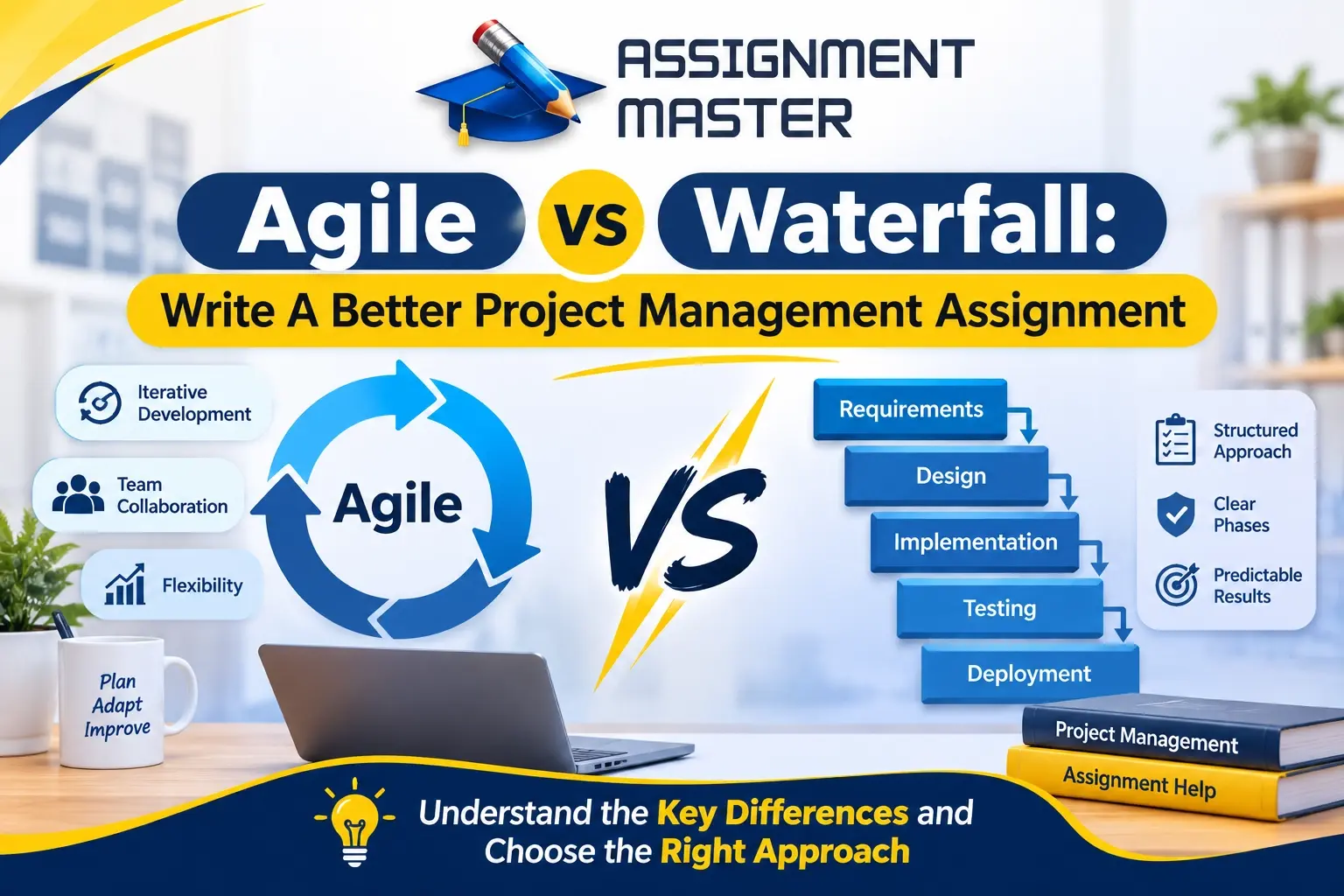
| Criteria | Waterfall fits when | Agile fits when |
| Requirements | Fixed and agreed early | Likely to change or still unclear |
| Change | Needs formal approval | Expected along the way |
| Stakeholders | Involved at set approval points | Available for regular feedback |
| Regulation or contract | Scope or compliance is fixed | Scope can flex |
| Delivery | One final handover | Working parts released in stages |
A school extension with signed drawings, planning permission and a fixed contract is easier to defend as Waterfall. A university building a student app, where each release is tested with students before the next one starts, points towards Agile.
Some cases need both. A project might follow Waterfall for budget approval and compliance while the delivery team works in sprints. Suggest a hybrid only when the case has both elements.
Whichever you pick, name the criteria in your answer. A bare preference is hard to defend and management assignment writing at this level rewards the reasoning more than the choice itself. The case facts that led you there turn it into a justification.
Step 3: Build the Core Project Documents
Start with the documents your brief asks for. Four of them apply to both approaches:
- Scope statement or charter: what the project delivers, for whom, and what is left out
- Work breakdown structure: the deliverables split into smaller work packages
- Risk register: each risk with its likelihood, impact and planned response
- Stakeholder analysis: who is affected, and how much influence and interest they have
The method changes the schedule. A Waterfall answer usually needs a Gantt chart with the critical path marked, so the reader can see which delay moves the end date. An Agile answer is better served by a prioritised product backlog and a sprint plan showing what each cycle delivers.
Give each document two or three lines of explanation tied to the case. A risk register that could belong to any project reads like a template. This is a common point to ask for project management assignment help, since every document has to point back to the case.
Step 4: Support Your Choices With Theory
A choice becomes a justification once a source stands behind it. Match the source to your method. PRINCE2 and the PMBOK Guide give you language for a plan-led approach, while the Agile Manifesto and the Scrum Guide cover the principles and sprint structure behind Agile. The APM Body of Knowledge works for either.
Then apply the source to the case. Say what it supports, where it helps and where it falls short. For the school extension, stage-based control suits the fixed contract, but it leaves little room if planning conditions change. Check your module guide for the sources your tutor expects.
Step 5: Edit and Proofread
Editing a project management assignment is mostly cross-checking. Go through these in order:
- Do the budget, timeline and team size match in every section? A figure that changes between your plan and your risk register is easy for a marker to spot.
- Does your recommendation follow from the criteria in your comparison?
- Are the tables, charts and figures labelled and referred to in the text?
- Is the referencing consistent? Harvard is common, but check the style in your module guide.
Check the word count last, because cutting a section can break the numbers you just matched.
Step 6: Submit
Before you upload, check that the file is in the format the brief asks for which is usually PDF or Word. Add your Gantt chart, backlog or risk register as appendices only if the brief allows them, and refer to each one in the main text. Confirm the deadline time and the platform you submit through, since the two don’t always match what you remember. If your university shows a similarity report, open it and check that your sources are referenced properly.
When Does Extra Support Make Sense?
Asking for support is reasonable when the workload or the method choice stops you from moving forward. These are the common moments:
- Two or three deadlines land in the same fortnight
- You can describe both methods but can’t decide which one the case supports
- The brief wants a charter, a Gantt chart, a risk register and a stakeholder analysis in one submission
- You have a draft and want someone to check the reasoning before you submit
Many students search “write my assignment” when deadlines stack up. What helps more is support that explains why a choice fits the case and reviews your structure and referencing, while the plan and the arguments stay yours. A tutor, your university’s academic skills service or a subject specialist can all do this.
Questions Students Often Ask
1- Is Agile or Waterfall better for an assignment?
Neither scores higher on its own. Markers look at whether your choice fits the case and whether you back it with criteria such as requirement stability and stakeholder availability. A well-justified Waterfall answer can outscore a weak Agile one.
2- Can I recommend a hybrid approach?
Yes, when the case shows both needs, such as fixed compliance rules alongside a team that delivers in short cycles. Say which parts follow which method and why, so it reads as a decision and not a way to avoid choosing.
3- How many project documents should I include?
Only what the brief asks for. Extra documents use up your word count. If appendices are allowed, put larger items like a full Gantt chart there and refer to them in the text.
4- Can I use a real project instead of the case study?
Only if the brief allows it, so check with your tutor first. You would also need enough detail on budget, timeline and risks to support your analysis.
5- What should I check before asking someone to write my assignment?
Read your university’s academic integrity policy first, then check what the support includes. Guidance, draft feedback and explanations of method choices keep the work yours. Submitting someone else’s work as your own can lead to a misconduct case.
Start With the Case
The brief that looked like a lot on the first read usually gets smaller once you sit with the case for an hour. The method, the documents and the arguments tend to follow from the facts in front of you, so the first step is to open the case and read it properly.
If the deadlines are close together, it’s fine to ask for a second pair of eyes along the way. Start with the case and take it one section at a time.