
How to Structure Your PhD Thesis Like a Pro
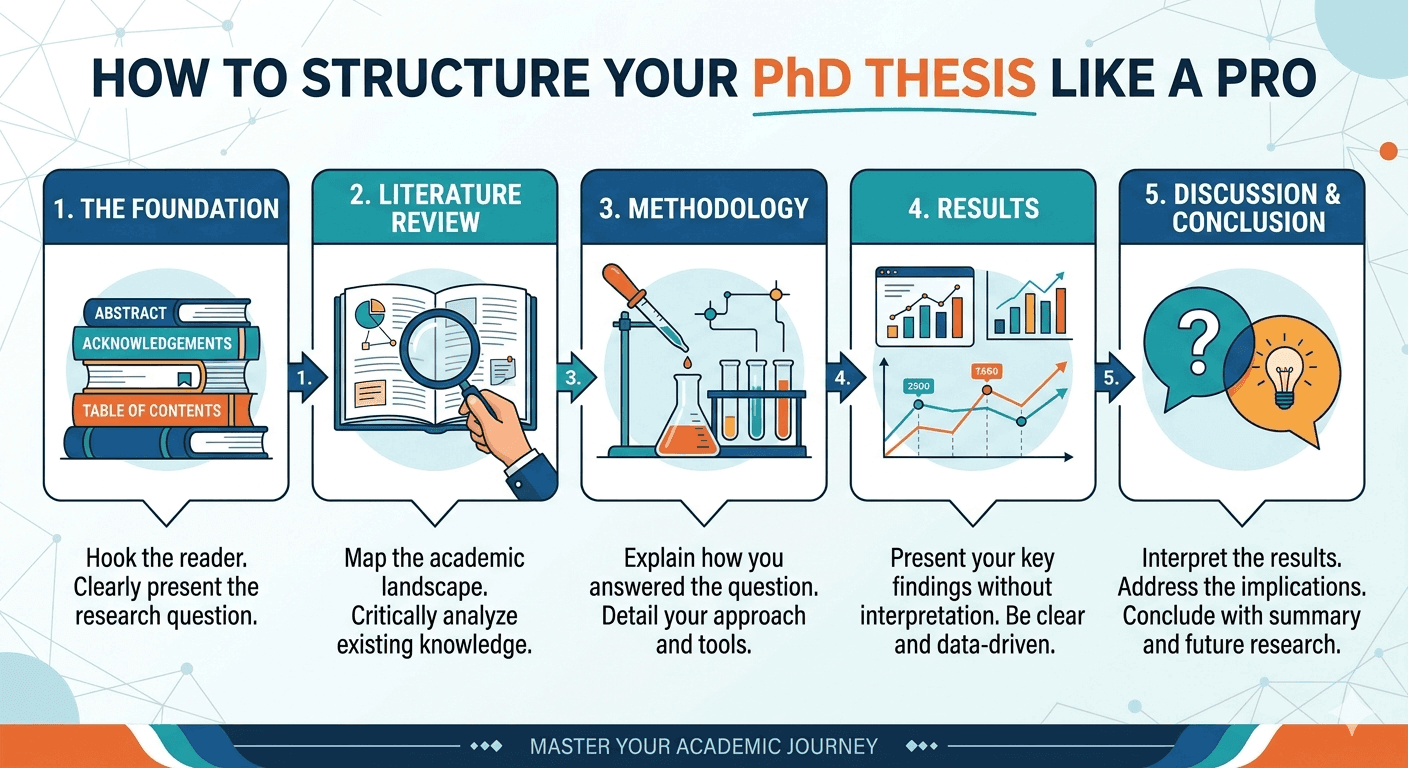
In 2026, the demand for academic credibility is high to reach the top of the list. You will see a lot of competition in your own field, and even more when you step into practical life, where they will closely assess how well you can perform and how much you have achieved with your degree so far. Here, your thesis plays a keen role in maintaining your image and telling those professionals that your expertise goes beyond surface-level details. And if we talk about writing a thesis, and that too for a major degree like a PhD is undoubtedly stressful. Here, structure is the backbone of your thesis, which ensures that the information you are presenting is convincing to the reader and that you are aware of how to deliver the insights of your study.
Beyond just organising your thoughts, a solid structure influences how people perceive your research. When a thesis lacks consistency, examiners feel precisely that way, and this might create some uncertain mishaps that you must not expect. So, in easy words, you can say structure functions similarly to a road map. It guarantees that your reader understands where they are, why it matters, and where they are going, and it also conveys professionalism, which is more significant. A well-written thesis subtly conveys your knowledge of the subject and commitment to academic norms.
What Goes Into Structuring a Compelling Thesis Foundation? Let’s Explore Each Aspect in Detail!
Most students often make the mistake of underestimating how essential it is to bring connectivity to their content, especially when they are presenting one of the most significant writings, such as a thesis. If you are not clear and confident before writing the first word, what happens in the end is that you have to go through endless revisions and might face delays in acceptances as well. So, what actually matters here and demands attention is how an individual who is still in the process of learning makes sure that their thesis is completely free from any kind of mistakes and blunders. Well, the only answer that could resolve this problem is to map your research narrative. You can start by determining what problem you are solving and continue adding why the topic you have choose matter for society and how it is contributing, and lastly, what you have interpreted from your study.
Your structure must focuses and cover the aspects like,
- The stage is set in the introduction.
- The review of the literature demonstrates what is previously known.
- The methodology describes how you addressed the issue.
- Your findings are presented in the results.
- The discussion explains them
- Everything comes together at the conclusion.
Also, the individuals who are tackling the complexities of thesis writing for the first time can always be inclined toward taking assistance from the PhD writing service, as these professionals make sure that your findings are perfectly aligned without missing any detail.
Now, We Are Going to Reveal How You Can Make Your Thesis Stand Out By Going Into Depth!
1. What Constitutes an Effective Chapter for the Introduction?
You must have determined the topic if you are seeking assistance with how you can start writing your thesis and the introduction steps in the discussion. Do not forget to understand or underestimate the fact that your introduction is your first impression, not just a formality. Furthermore, first impressions are more important in academics, especially than we would want to acknowledge. Consider your introduction as a conversation you are starting with your supervisor, rather than a list of background details. You can take a start with a broad approach before focusing on your particular research issue. How you can do it is to clearly state the gap in research, your goals, and the importance of your research. If you have performed well here, there is a high probability that your reader is already motivated to continue exploring the insights you are determined to present.
2. How Can a Literature Review Be Insightful Without Being Confusing?
If you are also browsing on the internet searching for write my dissertation and suddenly feel stuck on going forward because the literature review part has come, all you need is the correct direction. One of the most common mistakes you will see is that a lot of PhD candidates end up with a lengthy list of summaries for their literature review. A good literature review focuses on the connections between the work other people have done, in addition to what they have to say.
You can structure your research around disputes, themes, or approaches, and display gaps, inconsistencies, and patterns. Your objective should primarily focus on placing or reporting your research within the academic conversation. And, also, you will see students directing their way to seek assistance, which is quite all right as long as they intend to polish their work and improve its presentation.
3. What Makes a Great Methodology Different from a Good One?
Going forward, the next step, which actually covers what you performed, is explained by a well-written methodology, and here, a great one describes your motivation. Your examiner is assessing your decision-making as well as your approaches, so you need to be completely open and honest about elements like
- Your study methodology
- Techniques for gathering data
- An analytical method
Also, you need to delve further and explain your decisions by describing the options you thought about and the reasons you chose not to use them. High-level research is characterised by critical thinking, which is demonstrated here.
4. How Can Results Be Presented Without Excluding Readers?
Results chapters mostly get complicated and challenging to read, as the students often lose the plot, or you can say the tempo of their topic. So what you need at this point is clarity, as it is your finest tool here. Do not go for any hasty approach while presenting your findings, and make sure you sound logical and rational here. Make use of summaries, tables, and figures, but do not depend only on them. Give a simple explanation of what the data indicates and consider your reader to be knowledgeable but not familiar with your dataset. Gently lead them and do not sound like you are forcing them to comprehend your conclusions right away.
5. How Can I Write a Discussion That Reveals Credibility?
Progressing towards almost the end of the thesis, we have a discussion that typically demonstrates your skills. It is important to consider the significance of your findings, so what you do is make a connection between your results and the literature. Determine whether your findings lend credibility to current theories, put them to the test, or introduce a new idea? You can not possibly or simply repeat outcomes here and actually interpret them because that is how you can showcase your creativity. Seeking thesis help might offer perspective if you ever feel stuck at this point, particularly when converting complicated facts into insightful conclusions.
6. How Do You Compose a Conclusion That Produces an Influence?
Now you have reached the final stage of your thesis writing for a PhD, which is the conclusion that demands a proper and well-covered summarisation of your topic. Here, you need to bring everything together by rephrasing your research issue, emphasizing the main conclusions, and highlighting key findings. Once you are done here, take another step and explain the implications of these aspects and let the reader know what is altered by your research and what future researchers should consider investigating further about this topic. A professional conclusion has a sense of completion, and without being hurried, it provides the reader with a sense of closure.
FAQs
How can I write a compelling outline for my PhD thesis?
Determine your main research question first, then divide it into more manageable parts. One aspect of that question should be covered in each chapter.
How can I make sure that each chapter makes sense?
Every chapter should start with a quick reference to the one before it and conclude by laying out what will happen next. Your work will read much more smoothly if you use transitional sentences and draw clear connections between concepts.
How should a PhD thesis be organised?
The introduction, literature review, methodology, results, discussion, and conclusion make up the majority of a PhD thesis. The most important thing is that your framework effectively conveys your study process.
What are some common mistakes made in thesis structuring?
Some of the common mistakes include an uncertain study focus, poor transitions, and repetition. A well-structured thesis usually avoids these mistakes by keeping a unified narrative throughout.
Turn Structure into Strength
Many students have the common misconception that there is a formula for writing a thesis for a PhD level, but they do not understand that there is no secret to it. It demands your attention and concentration towards your topic, and once you understand the queries, the process of crafting a thesis that is persuasive and authentic becomes easier.